
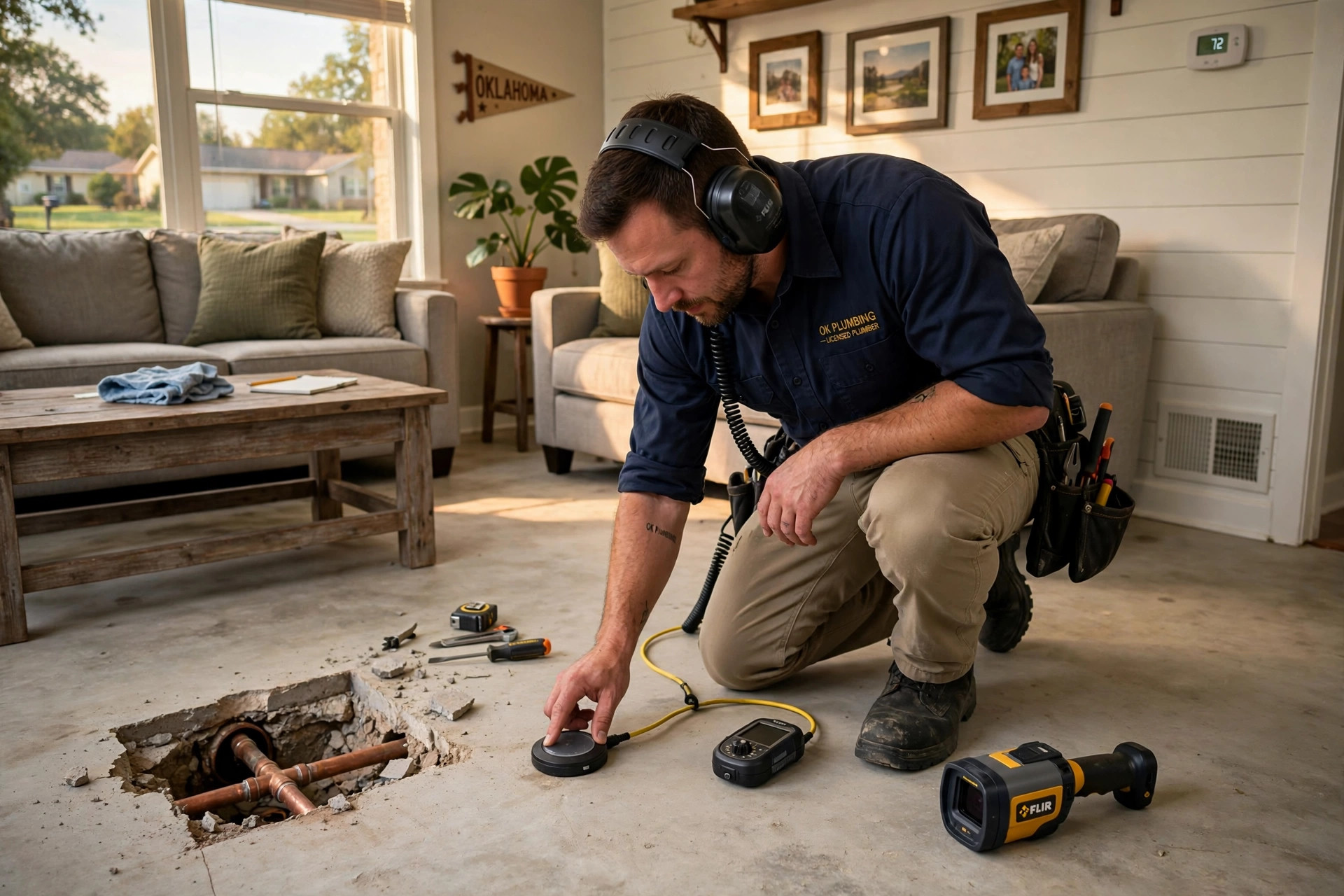
What Is a Slab Leak, Exactly?
A slab leak is any leak in the plumbing lines located under or inside your home's concrete foundation slab. The leak itself is rarely dramatic — the most common form is a pinhole leak in a copper supply line, small enough to hide for months while still wasting hundreds of gallons of water a day.
Two things make slab leaks different from an ordinary under-sink drip. First, the pipe is inaccessible: it is buried under inches of concrete, so you cannot see it, hear it clearly, or reach it with a wrench. Second, the escaping water has nowhere visible to go. It soaks into the soil beneath the slab, and the first clues are almost always indirect — a bill, a sound, a warm patch of floor — rather than a puddle you can point to.
That is why a slab leak is never diagnosed by looking at the pipe. It is diagnosed by slab leak detection: acoustic listening equipment, thermal imaging, and pressure testing that pinpoint the leak's location before any concrete is opened.
Pressure-Side vs Drain-Side: The Two Kinds of Slab Leaks
Not every under-slab leak behaves the same way. Which line is leaking changes the symptoms you see, how fast damage happens, and how urgent the call is.
| Pressure-side leak | Drain-side leak | |
|---|---|---|
| Which line | Supply line carrying pressurized water into the home | Drain or waste line carrying water away |
| How it leaks | Constantly — the line is always under pressure, day and night | Only when fixtures drain — showers, laundry, dishwashers |
| Typical clues | Water bill spike, running-water sound with taps off, warm floor spots | Musty odors, soggy spots, slow drains, occasional dampness |
| Speed of damage | Fast — a pinhole can waste 300+ gallons a day | Slower, but erodes soil and invites mold over time |
Most slab leaks Edmond plumbers get called about are pressure-side, because pressurized water escaping nonstop announces itself through the water bill. Drain-side leaks are quieter and often surface later, sometimes only when the soil erosion underneath starts to affect the slab itself. Both are real slab leaks, and both need locating before repair — but a pressure-side leak is the one that cannot wait a month.
If your water meter's leak indicator keeps spinning when every tap in the house is off, you are almost certainly looking at a pressure-side leak somewhere. That one test separates "watch it" from "call today."
7 Warning Signs You May Have a Slab Leak
- Your water bill spiked with no usage change. The single most common first clue. Water is going somewhere you cannot see, and under the slab is the first place to suspect.
- You hear running water when every tap is off. A pressurized line leaking under concrete makes a faint hiss or rush that shows up in quiet rooms, especially at night.
- Warm or hot spots on the floor. A hot-water line leaking under the slab warms the concrete above it. A noticeably warm patch in one room is the classic slab-leak signature.
- Water pressure dropped at every fixture. If the whole house lost pressure at once, supply water is escaping before it reaches your faucets.
- Damp areas, buckling floors, or lifting tile. Moisture migrating up through the slab swells wood, loosens tile, and darkens carpet padding.
- Musty smells or new mold growth. Persistent dampness under flooring creates the warm, dark conditions mold needs — often the first visible sign of a drain-side leak.
- New cracks in floors or walls. Escaping water erodes the soil supporting the slab; as support washes out, the foundation can settle unevenly and crack.
One sign alone can have an innocent explanation. Two or more together — especially a bill spike plus a warm floor — almost always mean water is escaping under the house. If the problem turns out not to be under the slab, whole-home water leak detection covers leaks behind walls and under upper floors instead.
What Causes Slab Leaks in Edmond Homes?
Slab leaks have a short list of usual causes, and Edmond's soil puts its own at the top:
- Expansive clay soil. Central Oklahoma's clay-heavy soil swells when wet and shrinks when dry. That slow, constant movement flexes rigid pipe buried under the slab until joints crack or pipe walls fatigue. Established neighborhoods like Oak Tree, with decades-old copper lines, feel this most.
- Corrosion. Mineral-heavy water thins copper pipe from the inside over years. Hot-water lines corrode fastest because heat accelerates the chemistry.
- Abrasion. Where a pipe rests against gravel, aggregate, or another pipe, decades of tiny vibration can rub through the metal — the classic pinhole leak.
- High water pressure. Pressure well above the residential norm stresses every joint and weak point in the system, all day, every day.
- Installation flaws. A pipe nicked, kinked, or over-bent during construction starts life weakened and fails years earlier than it should — a pattern seen even in newer builds around Deer Creek, where active soil meets fresh pipe runs.
- Age. Every pipe material has a service life. When one section of an aging system fails, nearby sections of the same age deserve scrutiny too.
These causes overlap, which is why one slab leak in a home's history raises the odds of another — the same soil, water, and pipe stock are still there. (A deeper look at causes, and how to weigh them, gets its own guide in this series.)
Why a Slab Leak Can't Wait
A slab leak never seals itself. While it runs, three separate problems grow at the same time.
The water bill is the smallest of them. Under the slab, escaping water erodes the compacted soil that supports your foundation. Once that support washes out, sections of slab can settle or crack — and a plumbing problem becomes a foundation repair problem, at foundation-repair prices.
Meanwhile the moisture migrates upward. Flooring warps, baseboards swell, and the damp space under your home becomes ideal for mold — a health issue layered on top of the structural one. Every week of delay adds water damage that the pipe repair itself will not undo.
Standing water indoors, a floor that is hot across a wide area, or the sound of rushing water under the floor is past the monitoring stage. Shut off the main water supply and treat it as an emergency.
What to Do If You Suspect a Slab Leak
You do not need to confirm the leak yourself — but two quick checks tell you whether to call today:
- Run the water meter test. Turn off every tap and water-using appliance, then check your water meter. If the dial or leak indicator is still moving after 15–20 minutes, water is escaping somewhere in the system.
- Feel and listen. Walk the floors barefoot for warm spots, and listen in the quietest room with everything off. Note which rooms show signs — that detail genuinely helps the technician.
- Know your main shutoff. Locate the main water shutoff valve and confirm it turns. If signs are severe, shut the water off before you call.
- Book detection before repair. An honest provider locates the leak first and quotes the repair second. Detection uses acoustic listening, thermal imaging, and pressure testing to mark the exact spot — so the repair, whether it is a spot fix, a pipe rerouting, an epoxy coating, or a repipe, opens the smallest possible area.
When you call Edmond Slab Leak Pros at (572) 205-4235, describe what you are seeing — the bill, the warm spot, the sound. We connect you with an independent local plumbing provider who can run the full detection sequence, usually in a single visit, and explain your repair options once the leak is located.
Slab Leak Questions, Answered
Straight answers to the questions Edmond homeowners ask us most.
Is a slab leak a leak in the concrete itself?
No. The concrete slab is not a pipe and does not leak. A slab leak is a leak in a water or drain line that runs beneath or through the slab — the name describes where the leaking pipe is, not what is leaking.
How do plumbers find a slab leak without digging up the whole floor?
With measurement, not excavation. A technician listens with acoustic ground microphones, scans with a thermal imaging camera, and pressure-tests individual lines to isolate the failing run. Done as a sequence, that locates most supply-line leaks to within inches — before a single hole is opened.
Is a slab leak an emergency?
Sometimes. A sudden bill spike with no other signs usually allows a scheduled detection visit. Standing water, a rapidly spreading wet patch, a hot floor across a wide area, or rushing-water sounds mean the main shutoff should be closed and the call made immediately.
Does homeowners insurance cover slab leak repair?
Often, partially. Many policies cover the cost of accessing the leak and the resulting water damage, but not the repair of the failed pipe itself — and every policy words it differently. Photograph any visible damage, keep the detection report, and call your insurer before authorizing the repair itself.