
What Causes a Slab Leak?
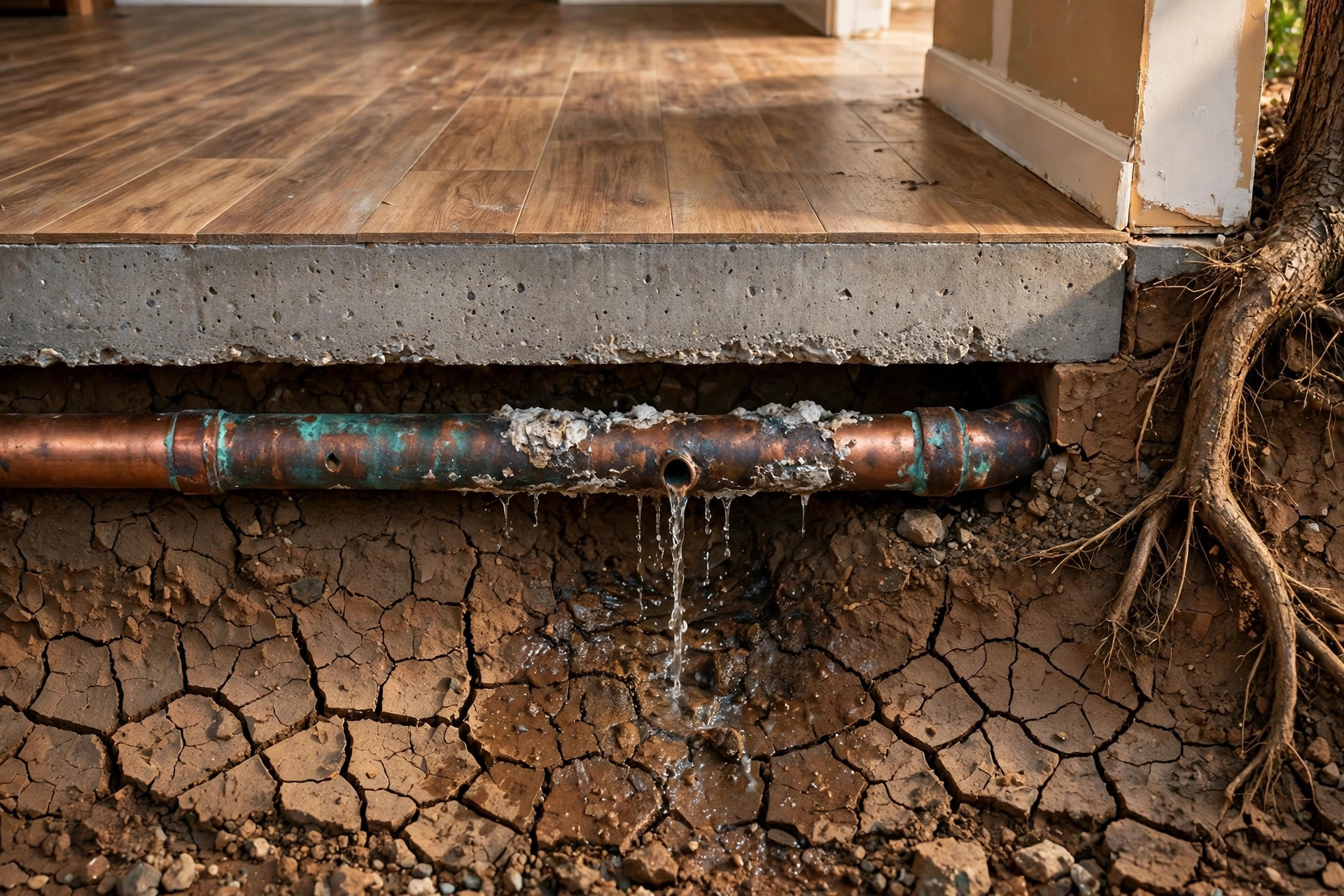
The most common causes of a slab leak are corrosion thinning copper pipes until pinholes form, pipes rubbing against concrete or gravel as they expand and contract, expansive clay soil shifting beneath the slab and stressing joints, high water pressure wearing out fittings, aging pipe materials reaching the end of their service life, poor original installation, and tree roots invading drain lines. In Edmond, the soil factor deserves special attention: central Oklahoma's expansive clay swells when wet and shrinks when dry, and that seasonal movement is one of the strongest local drivers of slab leaks.
1. Corrosion: The Slow Thinning That Makes Pinholes
Corrosion is the single most common cause of slab leaks in older homes, and it works quietly. Water chemistry reacts with the inside of a metal pipe over years — dissolved minerals and oxygen in the water gradually eat away at the pipe wall, and the damage is rarely even. It concentrates at weak points: bends, joints, and spots where the pipe was already slightly thinner from manufacturing. Eventually the wall gets thin enough that normal water pressure punches through, and you get a pinhole leak.
Copper is the usual victim, because most Edmond homes built from the 1960s through the early 2000s run copper supply lines under the slab. Copper does not rust the way iron does, but it does pit: tiny localized corrosion spots that deepen into pinholes. The process accelerates where water is hard or chemically aggressive, and it is worse on hot-water lines, because heat speeds up the chemical reactions inside the pipe. That is one reason a hot line is often the first to fail — and why the first sign of a slab leak is so often a warm patch on the floor.
A pinhole leak is not a one-off accident. When corrosion has thinned one section of pipe enough to fail, neighboring sections of the same line are usually in similar condition. That is why a plumber may talk about repiping rather than a single spot repair after a corrosion-driven leak — especially if a second leak appears soon after the first.
2. Abrasion: Pipes Rubbing Against Concrete
A pipe under a slab is not floating free. It sits against concrete, gravel, or another pipe, and every time hot water runs through it, the pipe expands slightly; when it cools, it contracts. Over decades, that tiny back-and-forth movement grinds the pipe wall against whatever it touches. The wear is worst at contact points — where a pipe passes through the slab, crosses another line, or rests on a sharp piece of aggregate in the bedding material.
Abrasion is a slow cause, which is why it rarely explains a leak in a young home but commonly contributes in a 30- or 40-year-old one. It also explains why leaks cluster at bends and elbows: those are the spots where expansion forces concentrate and where the pipe is most likely pressed against something hard. Proper installation wraps or sleeves pipes where they pass through concrete, but older work sometimes skipped that step — which links abrasion directly to the next cause on this list.
3. Edmond's Expansive Clay Soil: The Local Driver
This is the cause that separates Edmond from most of the country, and it is worth understanding properly. Central Oklahoma sits on expansive clay soil — clay that swells significantly when it absorbs water and shrinks hard when it dries out. Edmond's weather runs that cycle every year: wet springs and heavy rains swell the ground, summer heat dries it and pulls it back, and the ground beneath a slab heaves and settles in response.
That movement does not have to be dramatic to damage pipes. A slab is rigid; the pipes beneath it are rigid too. When the soil under one section of the slab swells or shrinks more than the soil under the next section, the slab and the pipes flex unevenly, and the stress concentrates at joints and bends — exactly the spots corrosion and abrasion have already weakened. Over many seasonal cycles, the joint gives way.
This is also why slab leaks in Edmond often seem to appear after a weather swing: a long dry summer followed by heavy rain, or a wet spring after a dry winter, is when the ground moves most. And it is why an unrepaired leak can become a foundation repair problem on top of a plumbing one — escaping water erodes the compacted soil supporting the slab, and the slab settles where its support washes out.
4. High Water Pressure
Residential plumbing is designed for a certain pressure range, and sustained pressure above it accelerates everything else on this list. High pressure pushes harder on every joint, fitting, and thinned pipe wall, turning a weakness that might have lasted years into a failure that happens this year. It also makes water hammer — the shock wave from a tap shutting suddenly — hit harder, which is especially rough on older joints.
Many homes have no pressure regulator at all, or have one that failed years ago without anyone noticing. High pressure rarely announces itself: you might notice taps that splash, a toilet that fills noisily, or a water heater relief valve that drips, but many homeowners just get used to strong showers. Unlike soil or pipe age, this is a cause you can actually measure and fix — a plumber can check your static pressure in minutes, and a regulator is a straightforward install.
5. Pipe Age and Material
Every pipe material has a service life, and Edmond's housing stock spans several of them:
- Copper (most common under slabs): long-lived but not immortal — pinhole corrosion typically shows up after 30–50 years, sooner with aggressive water chemistry.
- Galvanized steel: used in mid-century homes; corrodes from the inside out, narrowing the pipe and weakening the wall. By now, most surviving galvanized lines are well past their best.
- Cast iron (drain lines): corrodes from the inside out over decades, eventually cracking or collapsing. A cast-iron drain leak is a drain-side slab leak — it only leaks when fixtures drain, which makes it harder to spot.
- PVC (newer drain lines): does not corrode, but it can crack or separate at joints when the foundation moves — which brings the soil factor back into play.
Age alone is not a cause — a well-installed copper line in stable ground can outlast its expected life. But age plus any other cause on this list is the combination that produces most slab leaks. If your home is 40-plus years old and still on its original under-slab lines, the honest framing is not "if" but "which section goes first."
6. Poor Original Installation
Some slab leaks were set up on the day the house was built. Common installation defects include joints that were poorly soldered or crimped, pipes kinked during installation, lines laid without protective sleeving where they pass through concrete, and pipes bedded directly against sharp aggregate instead of sand. These defects do not fail immediately — a weak joint can hold for 20 years before the combination of pressure, corrosion, and soil movement finishes it.
There is no way to inspect under-slab installation quality without opening the floor, which is why this cause is usually diagnosed after the fact: a leak at a joint in a relatively young home, or a failure pattern that does not match the pipe's age, points back to the original work. When installation is the cause, the repair conversation usually shifts toward pipe rerouting — bypassing the defective section entirely rather than trusting a repair to a joint that was never right.
7. Tree Roots and Drain-Side Causes
Not every slab leak is a supply-line leak. Drain and sewer lines under the slab fail differently: tree roots seek out the moisture at tiny joint gaps, grow in, and widen the opening until the line cracks or blocks. A blocked drain then creates back-pressure that stresses the line further. Roots are a particular risk where large trees stand near the foundation — and in established Edmond neighborhoods like Coffee Creek, Oak Tree, and Deer Creek, mature trees and aging drain lines often share the same ground.
Drain-side leaks are easy to miss because they do not move the water meter — drains only carry water when fixtures empty into them. The signs are different too: musty odors along baseboards, slow drains, and damp spots that never fully dry, rather than a bill spike or a warm floor. They are found with a camera inspection, not a meter test, and fixed through sewer line repair rather than a supply-line repair.
Why Do Slab Leaks Appear When They Do?
Homeowners often ask what triggered the leak this month rather than last year. Usually the answer is a threshold being crossed: corrosion thinned the wall to the point where normal pressure was finally enough, or a seasonal soil swing added the last increment of stress to a joint. That is why leaks cluster after weather changes in Edmond — the ground moving is the final push on a pipe that was already close to failing. It is also why a leak rarely gets better on its own: the forces that caused it are still acting on the pipe.
Which Causes Can You Actually Do Something About?
Some causes are baked in — you cannot change your soil, your pipe's age, or how the house was built. But several are within reach:
- Check your water pressure. If it is high, a pressure regulator protects every joint in the system, not just the slab lines.
- Treat aggressive water. If your water is hard or corrosive, treatment slows the corrosion that makes pinholes.
- Manage trees near the foundation. Keep large trees from planting roots against the slab, and have drain lines camera-inspected if roots have been a problem before.
- Watch for the early signs. A bill spike, a warm floor patch, the sound of running water with everything off, or a damp spot that never dries — these are the early warnings. (The full signs checklist is covered in our guide to how to find a slab leak.)
What you cannot do is inspect under-slab pipes directly, which is why the practical version of prevention is early detection: catching the leak in its first weeks, before escaping water erodes soil and turns a plumbing repair into a foundation problem. Prevention in full — including the maintenance habits that extend pipe life — is covered in our guide to preventing slab leaks, coming soon.
What to Do If a Cause Has Already Done Its Damage
If you suspect a leak, the order of operations is the same regardless of cause: confirm it, locate it, then choose the repair. Confirmation starts with the water meter test; location takes professional slab leak detection with acoustic, thermal, and pressure-testing equipment. Once the spot is marked, the repair depends on the cause — a spot repair or water line repair for an isolated failure, rerouting for a defective section, or repiping when corrosion has aged the whole system. (Repair options are explained in depth in our guide to how to fix a slab leak.)
When you call Edmond Slab Leak Pros at (572) 205-4235, tell us your home's age, the pipe material if you know it, and which signs you have noticed. We connect you with an independent local plumbing provider who can confirm the leak, identify the likely cause, and lay out the repair options — before the damage spreads beyond the pipe itself. Edmond Slab Leak Pros is a referral service: we connect Edmond homeowners with independent local plumbers, and the provider who visits handles the inspection and repair.
What Causes a Slab Leak, Answered
Straight answers to the questions Edmond homeowners ask us most.
What is the most common cause of a slab leak?
Corrosion in aging copper supply lines is the most common single cause, usually combined with another factor — soil movement, high pressure, or abrasion — that finishes off a pipe wall corrosion had already thinned. In Edmond, expansive clay soil is the most common contributing factor alongside corrosion.
Can a slab leak be caused by a single event?
Rarely. A sudden event like a foundation shift can crack a line, but most slab leaks are the end of a years-long process: corrosion, abrasion, or soil movement weakening the pipe until normal pressure or one seasonal swing breaks through.
Why do hot water lines leak more often than cold ones?
Heat accelerates the corrosion chemistry inside copper pipes, and hot lines expand and contract more with each use, which increases abrasion at contact points. That is why the first sign of a slab leak is often a warm patch on the floor.
Does Edmond's clay soil really cause slab leaks?
It is a major contributing cause. Central Oklahoma's expansive clay swells when wet and shrinks when dry, and that seasonal movement stresses pipe joints and bends under the slab — especially joints already weakened by corrosion or age. Homes in older Edmond neighborhoods with original copper lines are the most exposed.
Can I prevent a slab leak?
You can reduce the risk: keep water pressure in range, treat aggressive water, manage tree roots near the foundation, and act on early signs fast. You cannot eliminate the risk entirely, because soil movement and pipe age are outside your control — which is why early detection matters as much as prevention.
If corrosion caused my leak, will it happen again?
Possibly, in a different section of the same system. Corrosion affects the whole line, not just the spot that failed. That is why a second leak shortly after the first usually shifts the conversation from a spot repair to rerouting or repiping.