
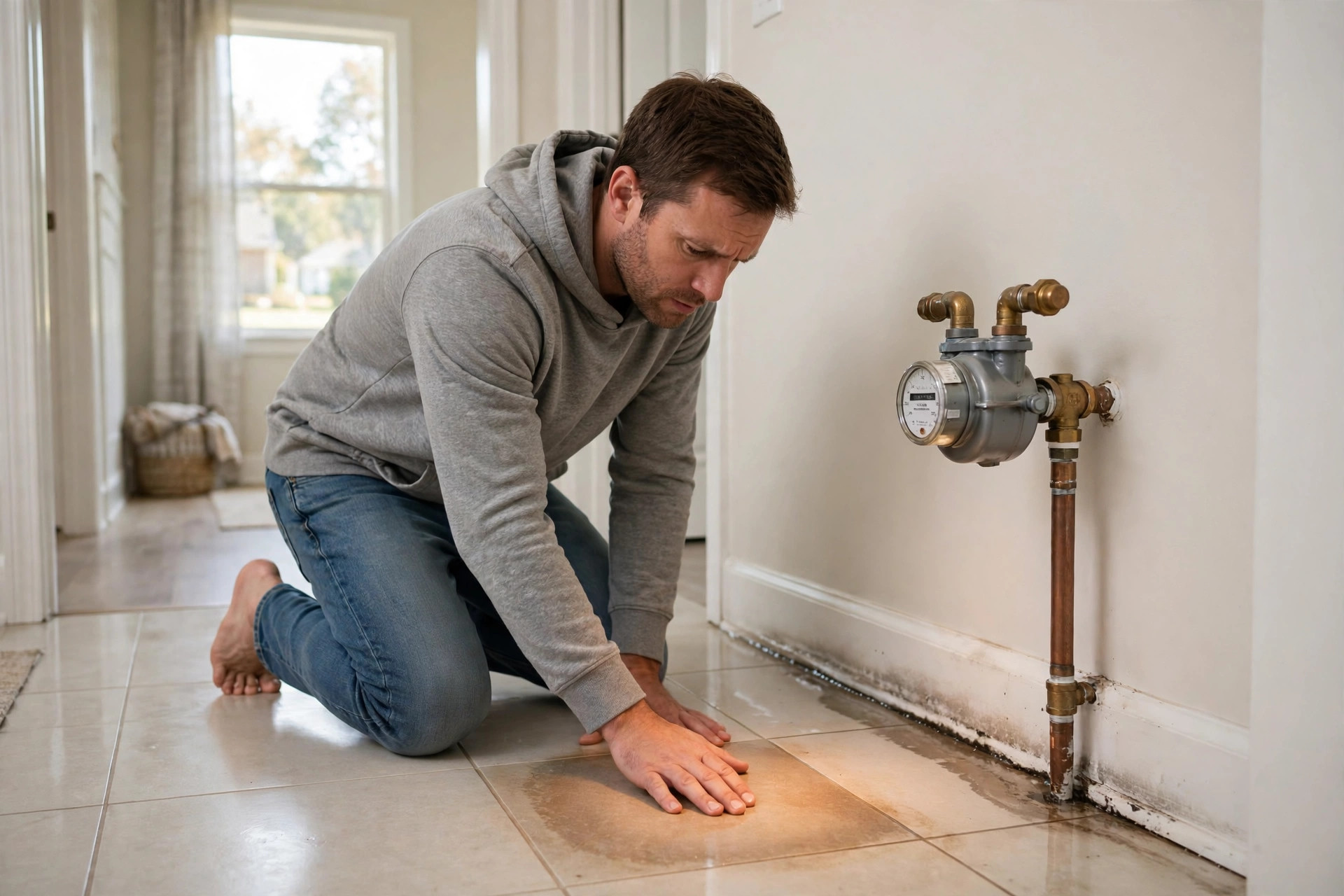
How Do I Know If I Have a Slab Leak?
You most likely have a slab leak if you notice two or more of these signs together: an unexplained rise in your water bill, a water meter that keeps moving when every fixture is off, a warm spot on the floor, the sound of running water with nothing on, damp or warped flooring, a musty smell along baseboards, a drop in water pressure, a soggy or extra-green patch of lawn near the foundation, or new cracks in walls or floors. One sign alone is a reason to watch; two or more is a reason to act; a meter that moves with everything off is the closest thing to proof you can get without professional equipment — and it means you should call today.
1. Your Water Bill Climbs for No Reason
This is the sign most homeowners notice first, and often the only sign for weeks. A pressurized supply line under the slab leaks continuously, 24 hours a day, whether you are using water or not. Even a small leak adds up over a billing cycle, so the bill climbs steadily rather than jumping all at once — which is exactly why it is easy to dismiss for a month or two as a rate change or a heavy-use month.
Check it properly: compare the current bill with the same month last year, not just last month. If usage is up by a clear margin and nothing in the household changed — no guests, no new appliance, no lawn work — water is escaping somewhere in the system. The bill alone cannot tell you the leak is under the slab, but it is the sign that should start the investigation, not end it.
A steadily climbing bill points to a pressurized supply-line leak. A drain-side leak will never show up on your bill at all, because drains only carry water when fixtures empty into them — so a normal bill does not rule out a drain-line slab leak. The drain-side signs are covered below.
2. Your Water Meter Moves With Everything Off
This is the single most useful check a homeowner can do, and it takes about 15 minutes:
- Turn off every tap, appliance, and fixture in the house — including the dishwasher, washing machine, and ice maker — and switch off the irrigation system.
- Go to the water meter and find the low-flow indicator, usually a small triangle or dial that spins when even a small amount of water is flowing.
- If the indicator is moving, water is flowing somewhere. Note the meter reading, use no water for an hour, and check again — a changed reading confirms an active leak.
A moving meter proves there is a leak in the system, but it does not prove the leak is under the slab. It could be a running toilet, a yard line, or a wall pipe. That is why the meter test is a confirmation step, not the whole diagnosis: it tells you the leak is real, and the other signs in this guide tell you whether the slab is the likely location. If the meter moves and you also have a warm floor spot or damp flooring, the slab is the leading suspect.
3. A Warm or Hot Spot on the Floor
Walk barefoot across your tile or hardwood floors. If one patch is consistently warm while the rest of the floor is not — and there is no heating vent, sunny window, or appliance above it — you may be standing over a hot-water line leak. Escaping hot water warms the concrete above the break, and the heat travels up through the flooring.
This sign is specific: it points to a hot-water supply line, not a cold one, because only a hot line carries enough heat to warm the slab. It is also more noticeable on tile and concrete than on carpet, which insulates. A warm spot that stays in exactly the same place for days, and does not follow the time of day or the weather, is the pattern to watch for. (Hot lines fail first more often than cold ones — heat speeds up the corrosion inside copper pipe, as explained in our guide to what causes a slab leak.)
4. Damp, Warped, or Buckling Flooring
Water escaping under the slab does not stay put. It migrates upward through the concrete and into whatever sits on top of it. Look for carpet that stays damp in one spot with no spill to explain it, hardwood that cups or warps in one area, vinyl or laminate that bubbles or lifts, and tiles that loosen or crack along one grout line.
This sign usually means the leak has been running for a while — long enough for moisture to travel through the slab and saturate the flooring. That also makes it one of the more urgent signs: the same moisture that is warping your floor is saturating the soil beneath the slab, and if it keeps going, the soil erosion can lead to settlement and cracking that turns a plumbing repair into a foundation repair problem.
Do not just dry the spot and move on. A damp patch that returns after drying, or that never fully dries, is not a spill — it is a water source underneath. Drying the surface without finding the source lets the leak keep eroding soil out of sight.
5. The Sound of Running Water With Nothing On
Stand quietly in a room near the floor, with every tap, appliance, and toilet off. If you hear a faint hissing, trickling, or running-water sound coming from the floor or from a wall at floor level, that is pressurized water escaping through a break in a supply line. The sound is often clearest at night, when the house is quiet.
This sign is a strong one, because very few other household problems make that sound with everything off. A toilet that runs makes a different sound and stops when you lift the tank lid; a refrigerator ice maker cycles on and off. A continuous hiss from the floor that does not stop is a leak talking. If you hear it, run the meter test above — the two together are a very strong case.
6. A Musty or Mildew Smell Along Baseboards
Persistent moisture under a slab feeds mold and mildew in the flooring and baseboards above it, and the smell is often noticeable before any visible dampness. If one room — or one stretch of baseboard — smells musty no matter how often you clean it, and the smell does not follow a roof leak or a plumbing fixture, suspect moisture coming from below.
This sign is also the main calling card of a drain-side leak. Drain lines under the slab leak only when fixtures drain, so they never move the meter and never spike the bill — but they do release moisture and odor steadily. A musty smell paired with slow drains or gurgling fixtures points toward the drain side, which is found with a camera inspection rather than a meter test, and fixed through sewer line repair.
7. A Drop in Water Pressure
A significant supply-line leak diverts water before it reaches your fixtures, so pressure drops — sometimes across the whole house, sometimes at the fixtures nearest the leak. If showers that used to run strong now feel weak, and the change came on gradually rather than overnight, a leak is one of the causes worth ruling out.
Pressure drop alone is a weak sign, because it has many other causes: a failing pressure regulator, a partially closed valve, mineral buildup in older pipes. Treat it as supporting evidence, not a verdict. It matters most in combination — low pressure plus a bill spike, or low pressure plus a warm floor spot, is a much stronger picture than low pressure on its own.
8. A Soggy or Extra-Green Patch Near the Foundation
Escaping water does not only travel upward — it also travels sideways and outward through the soil. Outside, that shows up as a patch of lawn or garden bed that stays soggy with no recent rain or irrigation, or a strip of grass that grows noticeably greener and faster than the rest of the lawn along the foundation line.
In Edmond, check this sign against the weather before concluding anything: a heavy rain or a sprinkler zone can mimic it. The pattern that points to a leak is a patch that stays wet or green in one spot while the rest of the yard dries out, and that does not move when you adjust the sprinklers. A soggy patch plus an indoor sign — a bill spike, a warm floor — is a strong combination.
9. New Cracks in Walls, Floors, or the Foundation
This is the sign that means the leak has been running long enough to affect the structure, and it is the one to take most seriously. Escaping water erodes the compacted soil supporting the slab, the slab settles unevenly where its support washed out, and the movement shows up as new cracks in interior walls, door frames that no longer close properly, cracks in tile grout lines, or cracks in the slab or patio near plumbing routes.
In Edmond this sign deserves extra attention. Central Oklahoma's expansive clay soil swells when wet and shrinks when dry, so the ground beneath a slab already moves seasonally — and a leak adds water-driven erosion on top of that movement. Homes in established Edmond neighborhoods like Coffee Creek, Oak Tree, and Deer Creek, where mature trees and aging original copper lines share the same ground, are the most exposed. New cracks plus any other sign on this list mean you should not wait for the next billing cycle.
Reading the Signs Together: Watch, Test, or Call Today?
No single sign proves a slab leak, and that is the trap: homeowners either panic over one weak sign or ignore a strong combination. Use this scale:
- Watch (one weak sign): a slightly higher bill, a faint smell in one room, or a small pressure change on its own. Note it, check again in a week, and run the meter test.
- Test (one strong sign, or two signs): a warm floor spot, the sound of running water, or any two signs together. Run the meter test today — it takes 15 minutes and turns suspicion into evidence.
- Call today (meter moving, or cracks, or three or more signs): a meter that moves with everything off, new cracks, damp flooring that will not dry, or any three signs together. These mean an active leak is already doing damage, and every week it runs is more soil eroded and more flooring ruined.
| What you found | What it most likely means | What to do |
|---|---|---|
| One weak sign (bill, smell, pressure) | Could be a slab leak, could be something else | Watch a week, run the meter test |
| Warm floor spot or running-water sound | Hot-line or supply-line leak under the slab | Run the meter test today |
| Meter moving with everything off | Confirmed active leak somewhere in the system | Call for professional detection |
| Damp flooring that will not dry | Leak running long enough to saturate the slab | Call today |
| New cracks or doors sticking | Soil erosion and settlement already underway | Call today — do not wait |
| Musty smell + slow drains, normal bill | Drain-side leak under the slab | Camera inspection, not a meter test |
Signs That Are Usually Something Else
Not every damp spot or high bill is a slab leak, and ruling out the lookalikes saves a needless investigation:
- A running toilet is the most common cause of a bill spike that is not a slab leak. Put food coloring in the tank; if color appears in the bowl without flushing, the toilet is the culprit.
- An irrigation or yard-line leak produces soggy lawn patches and a moving meter, but no indoor signs. Shut off the house main valve: if the meter stops, the leak is inside the house; if it keeps moving, it is in the yard line.
- A wall-pipe leak shows as a damp patch on a wall, not the floor, and usually appears near a bathroom or kitchen fixture.
- Condensation or a roof leak produces dampness after rain or in humid weather, not a constant damp spot that ignores the weather.
The shut-off test above is the quickest way to separate an indoor leak from an outdoor one, and the meter test separates a real leak from a billing error. If both point indoors and the floor signs are present, the slab is the leading suspect.
What Happens After You Confirm It
Confirmation is not the end of the process — it is the point where guesswork stops and location starts. The next step is professional slab leak detection: acoustic listening, thermal imaging, and pressure testing that pinpoints the break to a small area, so only a minimal section of floor needs to be opened. (How that equipment works, step by step, is covered in our guide to how to find a slab leak.) Once the spot is marked, the repair depends on what failed — a spot repair, pipe rerouting, or repiping when the whole system has aged out. (Repair options are explained in our guide to how to fix a slab leak.)
If the signs point to an emergency — water visibly pooling, a floor buckling fast, or cracks spreading — an emergency plumber can shut things down and stabilize the situation before the full detection visit.
When you call Edmond Slab Leak Pros at (572) 205-4235, tell us which signs you have noticed and what the meter test showed. We connect you with an independent local plumbing provider who can confirm the leak and locate it precisely. Edmond Slab Leak Pros is a referral service: we connect Edmond homeowners with independent local plumbers, and the provider who visits handles the inspection and repair. We are based at 2803 Broadway Ct, Edmond, OK 73013.
How Do I Know If I Have a Slab Leak, Answered
Straight answers to the questions Edmond homeowners ask us most.
What is the first sign of a slab leak most homeowners notice?
Usually the water bill. A supply-line leak runs 24 hours a day, so the bill climbs steadily over one or two billing cycles even though household usage has not changed. It is easy to dismiss for a month, which is why comparing with the same month last year — not just last month — is the right check.
Can one sign alone prove I have a slab leak?
No. Every sign on this list has other possible causes, from a running toilet to a sprinkler leak. The reliable verdict comes from combinations: two or more signs together, or any sign plus a meter that moves with everything off.
How do I do the water meter test?
Turn off every tap, appliance, and fixture, including the washing machine, dishwasher, and ice maker, and switch off irrigation. Check the meter's low-flow indicator (a small triangle or dial); if it is moving, water is flowing. Note the reading, use no water for an hour, and check again — a changed reading confirms an active leak.
Why does a slab leak make one spot on the floor warm?
Because the leaking line is a hot-water line. Escaping hot water warms the concrete above the break, and the heat travels up through the flooring. A warm spot that stays in exactly the same place, on tile or hardwood, is the classic hot-line sign. Cold-line leaks do not warm the floor.
Why doesn't my bill go up if I have a drain-side slab leak?
Because drain lines only carry water when fixtures empty into them — they are not pressurized, so they do not leak continuously and never register on the meter or the bill. Drain-side signs are different: musty odors, slow drains, and damp spots that never fully dry. They are found with a camera inspection, not a meter test.
My meter moves but I see no other signs — is it still a slab leak?
It is a confirmed leak somewhere in the system, but not necessarily under the slab. Use the shut-off test: close the house main valve, and if the meter stops, the leak is inside the house; if it keeps moving, it is in the yard line. If it is inside and no floor signs are present yet, the leak may be in a wall line or an early-stage slab leak — either way, professional detection is the next step.
How urgent is it if I see new cracks in my walls?
Treat it as urgent. Cracks mean escaping water has already eroded soil beneath the slab enough for the slab to settle unevenly. The longer the leak runs after that point, the more the settlement spreads — and the repair grows from a plumbing fix into a foundation problem. Call the same day.