
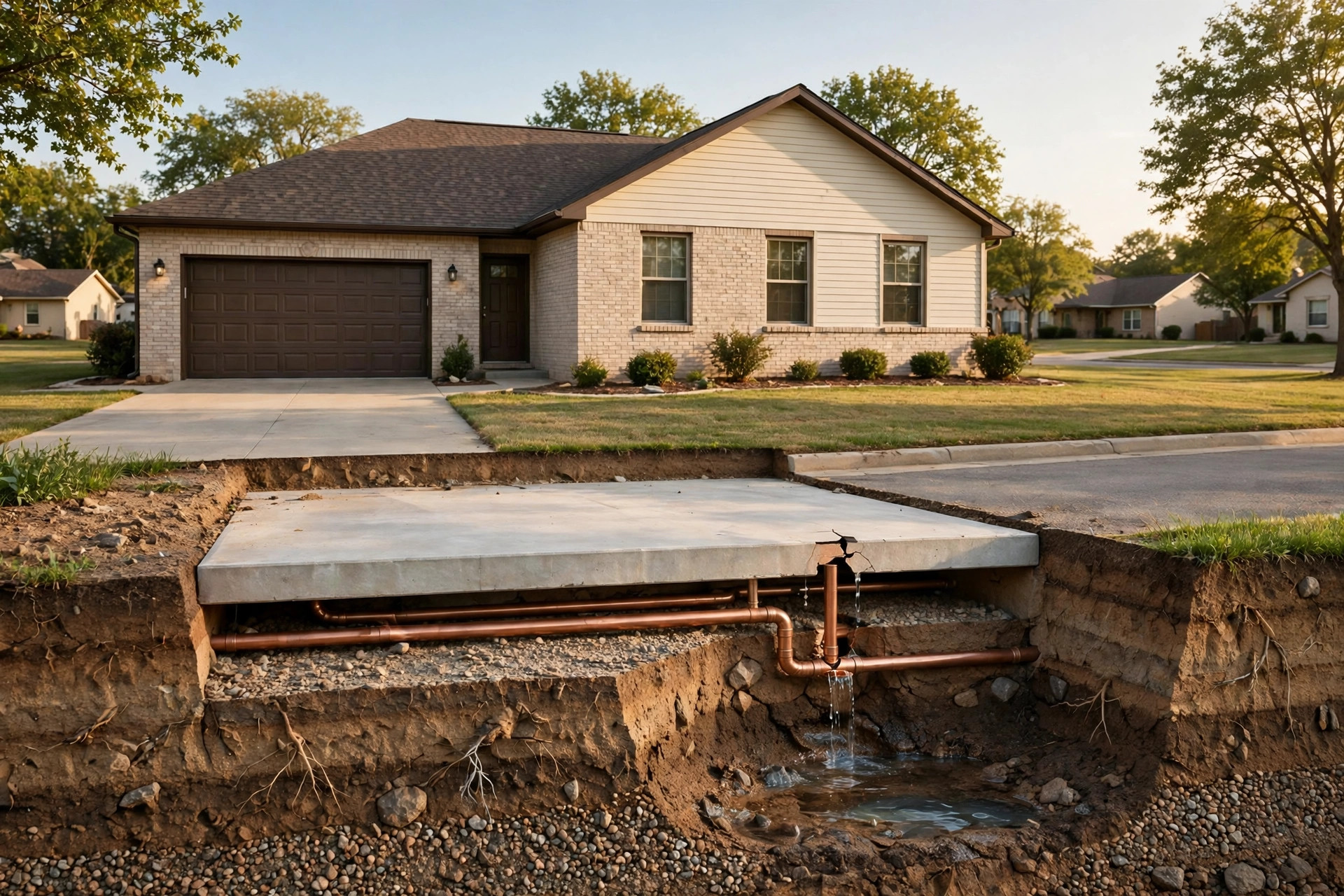
Common, Rare, or Somewhere in Between?
So here is the honest answer: slab leaks are uncommon enough that most homeowners never think about them, and common enough that plumbers in slab-heavy regions deal with them regularly. Which of those is true for you depends almost entirely on your home. A newer home on stable soil with modern piping is in a very different risk group from an older home on shifting clay with original copper lines under the slab. This guide explains why the answers disagree, what actually raises your risk, and where Edmond homes sit on that scale.
If you need the basics first, start with what a slab leak is: a leak in a water or drain pipe buried under your home's concrete foundation, hidden from view until its effects reach the surface.
The confusion comes from the word "common" doing three different jobs:
- For one average home, over its lifetime: a slab leak is not an everyday event. Plenty of slab homes go decades without one, and many never have one at all. If someone quotes you a precise national percentage — a share of homes that will get one — ask where it came from. No widely cited, authoritative figure exists, and this article will not invent one.
- As a type of plumbing call: slab leaks are a regular, recognized job. Plumbers who work in areas with slab foundations and clay soil diagnose them often enough that detection equipment and repair methods are standard, not exotic. A leak type can be a routine professional job without being something every homeowner experiences.
- In high-risk homes: slab leaks are genuinely frequent. In an older home with aging copper under a slab on expansive soil, a leak is not a freak event — it is one of the likelier plumbing failures that home will face.
So when one article says "rare" and another says "very common," they are usually describing different groups of homes. The useful question is not how common slab leaks are in general. It is how common they are for a home like yours.
What Actually Raises the Odds
No single factor causes a slab leak on its own. Risk stacks: the more of these your home has, the more the odds tilt.
| Risk factor | Why it matters |
|---|---|
| Older home, original plumbing | Pipes age, corrode, and weaken over decades; copper lines installed decades ago are the classic slab-leak candidate |
| Expansive clay soil | Soil that swells when wet and shrinks when dry moves constantly, stressing buried pipes — central Oklahoma clay is a textbook example |
| Slab foundation with buried lines | A leak can only be a "slab leak" if pipes run under the slab; homes on crawl spaces or basements face different leak types instead |
| Hard or mineral-heavy water | Mineral content can corrode pipes from the inside over time, thinning walls until a pinhole or crack opens |
| Faulty installation or poor construction | Kinks, bad joints, or pipes laid against rough concrete wear through faster than properly installed lines |
| Shifting ground and erosion | Soil movement, nearby water flow, and ground settling all flex and abrade buried pipe |
A home with one of these factors is not doomed to a leak. A home with three or four — say, a 1970s home with original copper, on clay soil, with hard water — is squarely in the group where slab leaks show up regularly. The full story of how each factor damages a pipe is covered in our guide to what causes slab leaks.
Age alone is a weak predictor. A well-installed, well-maintained pipe system in a newer home can outlast an older, poorly installed one. What matters is the combination: age plus pipe material plus soil plus water quality. If you know your home's build year and pipe material, you already know more about your risk than any national average could tell you.
Where Edmond Homes Sit on the Scale
Edmond is not a low-risk city for slab leaks, and the reason is the ground. Central Oklahoma's expansive clay soil swells in wet weather and shrinks in dry weather, and that cycle repeats every year. Each cycle moves the soil under the slab a little, and buried pipes absorb that movement. Over years, the stress adds up — especially on older copper lines.
That does not mean every Edmond home is at high risk. It means the local risk is above average for the country as a whole, and it concentrates in particular homes:
- Older neighborhoods with original plumbing, such as Oak Tree, where aging supply lines have had decades of soil movement to endure.
- Larger slab homes, such as many in Coffee Creek, where more buried line simply means more pipe that could fail — though newer materials in newer builds offset some of that.
- Any home where the soil stays wet or dries unevenly — poor drainage, a downspout dumping beside the foundation, or a yard that holds water on one side and bakes on the other all make the clay move more.
If your home is newer, with modern piping materials and good drainage, your personal risk is much lower than the Edmond average. If it is older, with original copper and clay soil, your risk is much higher. The city-wide picture matters less than your home's profile.
Reading Your Own Home's Risk
You do not need a plumber to get a rough read on your risk. Work through these questions:
- How old is the plumbing? Original pipes from a home built decades ago carry more risk than a system replaced or rerouted in recent years.
- What material are the pipes? Aging copper under a slab is the highest-risk classic combination; modern PEX and other flexible materials handle soil movement better.
- Is your home on a slab? If your home has a crawl space or basement, a pipe leak is a different problem — still worth fixing, but not a slab leak.
- Does your soil move? Cracks in driveways or patios, doors that stick seasonally, and visible soil shrinkage in dry months all hint at active clay.
- Is your water hard? Scale buildup on fixtures is a visible clue that mineral content is working on your pipes too.
- Have you had a leak before? A home that has had one slab leak is more likely to have another, because the same pipes, soil, and water are still in place.
Three or more yes answers in the risk direction put you in the group that should take warning signs seriously rather than waiting them out. Zero or one puts you in the lower-risk group — but "lower risk" is not "no risk," and the warning signs below still apply.
A previous slab leak is the strongest single predictor of another one. If your home has had a leak repaired by a spot fix, the rest of the original pipe system is still the same age, in the same soil, carrying the same water. That is worth knowing before you assume the problem is permanently behind you.
What to Watch For, Whatever Your Risk
Risk tells you how likely a leak is. Warning signs tell you whether one may already be happening. The classic signs — a water bill that jumps without explanation, a warm spot on the floor, damp carpet or flooring, a musty smell, the sound of running water when every tap is off, or cracks appearing in floors and walls — are covered in detail in our guide to the signs of a slab leak.
One cheap check works for any home: turn off every tap and water-using appliance, then watch your water meter for 15–20 minutes. If the meter keeps moving, water is escaping somewhere in the system. That test does not prove the leak is under the slab — it could be behind a wall, under a floor, or in a yard line — but it proves something is leaking, and that is enough to justify a detection visit. Whole-home water leak detection covers leaks outside the slab too, so a meter that moves is worth following up even if the slab turns out not to be the source.
If Your Risk Is High — or a Sign Has Appeared
High risk alone does not mean you need a repair. It means two things are worth doing: pay attention to the warning signs above, and do not sit on them if they appear. A leak caught in its first weeks is a contained plumbing job; the same leak left for months can add flooring, mold, and foundation costs on top, as our guide to whether slab leaks are dangerous explains.
The right first step is detection, not a repair quote: acoustic listening, thermal imaging, and pressure testing locate the leak before any concrete is opened, and the repair options depend on what detection finds.
When you call Edmond Slab Leak Pros at (572) 205-4235, tell us your home's age, pipe material if you know it, and what signs you have noticed. We connect you with an independent local plumbing provider who can run the full slab leak detection sequence and explain your options once the leak is located. Edmond Slab Leak Pros is a referral service: we connect homeowners with independent local plumbers, and the plumber who visits handles the detection and repair. Our office is at 2803 Broadway Ct, Edmond, OK 73013.
How Common Are Slab Leaks? Questions, Answered
Straight answers to the questions Edmond homeowners ask us most.
Will my home definitely get a slab leak someday?
No. Many slab homes never have one. Risk depends on your home's age, pipe material, soil, and water quality — not on a fixed fate. Older homes on clay soil with original copper are the high-risk group; newer homes with modern piping are much lower risk.
Are slab leaks more common in Oklahoma than elsewhere?
Oklahoma's expansive clay soil does raise the risk compared with regions on stable soil, because the soil's wet-dry cycle stresses buried pipes year after year. That makes Edmond a higher-risk city than average, but the risk still varies home by home.
Do new homes get slab leaks?
They can, though it is less likely. Faulty installation, poor construction, or a bad joint can fail early in any home. Newer materials handle soil movement better than aging copper, which is why new-home slab leaks are the exception rather than the pattern.
If my neighbor had a slab leak, does that mean I will too?
Not necessarily, but it is a useful warning. Neighbors often share soil conditions, build era, and sometimes the same original pipe material, so a neighbor's leak raises the chance that your home shares the risk factors — without guaranteeing the same outcome.
How do I know if I already have one?
Watch for a rising water bill, warm spots on floors, damp or warped flooring, musty odors, running-water sounds with taps off, and new cracks. Run the water-meter test with everything off: a moving meter means water is escaping somewhere, and detection can pinpoint whether it is under the slab.